
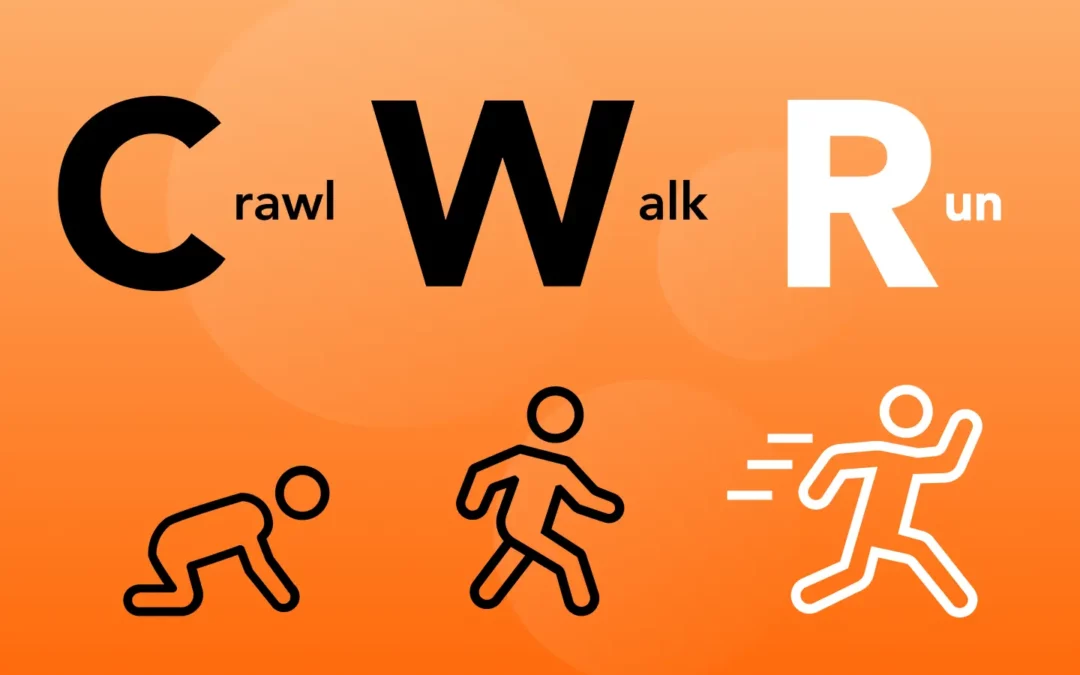
This is the third part of our three-part series that walks you through our phased approach to web design and development. As a recap, a crawl website establishes your digital footprint, while a walk website expands and enriches its content. With a run website, we aim to maximize your digital reach and effectiveness through a CRM, deeper social media engagement, retargeting, advanced analytics, and more.
If you’re ready to take on a run website, keep reading to learn what you need.
It’s Time for a CRM
If you’re unfamiliar with Customer Relationship Management (CRM), it’s software that tracks and manages your customers. A CRM requires business processes, integrates with your website to collect customer information, and automates follow-up. There are several CRM options, including Zoho, Salesforce, and HubSpot.
Here are a few reasons why your run website needs a CRM:
- CRMs allow you to maintain customer records, including lead status, notes, and lead source. This information provides transparency into customer demographics and their stage along the sales pipeline.
- CRMs are powerful tools for optimizing sales. You can create separate pipelines for different customers and explore which works best. In doing so, you increase your sales conversions.
- CRMs offer automation. You can set triggers to send emails and follow-up reminders at specific cadences, or add cold leads to a weekly newsletter. In other words, CRMs free up your time to do higher-value-added tasks.
For help with CRM integrations, contact a web design and digital marketing agency for a free consultation.
Use Social Media for Greater Reach
During the run phase, your brand should be in front of the largest audience possible. Social media amplifies your voice to existing and potential customers and should never be used without tracking pixels or a strategy in place.
Social media can be leveraged in the following ways:
- The first is to increase impressions. Share engaging content, such as blog articles, news, or an exciting update about your company. The objective is to create compelling content that encourages prospects to engage with your post by liking, commenting on, or sharing it. These actions do two things: 1) leverage network effects and 2) prioritize your content over competitors on your customers’ social feeds.
- The second is to increase leads. Social media ads can be used for this, but they tend to be more expensive than search engine ads. That’s because, with social media, customers are skipping search to find you, and targeting can be more finely tuned than in PPC to reach your ideal customer.
Regardless of how you plan on using social media, your website must accommodate it. Integrations must happen between your website and your social media channels. That means you must have working tracking pixels on your website to relay data to your social media advertisers.
Retarget Your Customers through Omni-Channels
On average, it takes 7+ touchpoints with a customer before they take notice of your brand. Let that sink in for a minute. Your website is one of those touchpoints and needs help to reach seven. Wouldn’t it be nice if your brand were top of mind for your customers as they go about their daily lives with little effort? Introducing retargeting, where ads are served and reserved according to your customers’ search habits.
As customers engage with your website after clicking an ad, your advertisers can build audiences using their demographic, search, and other data. Based on this data, you can determine what these audiences will be targeted with next. Targeting is great for squeezing out every last drop of qualified traffic. Google Display Network, LinkedIn, and TikTok are popular retargeting platforms.
Implement Advanced Website Analytics
In previous phases, you used Google Analytics as your go-to tool for capturing standard website data. In the run phase, you go beyond Google Analytics. Hotjar is a paid, advanced analytics tool that provides heatmaps tracking your customers’ mouse movements. Microsoft Clarity is a great free alternative.
The next tool that elevates your analytics is Google Tag Manager. It provides granular control over tracking, including which buttons and resources are clicked on a page. You can also use it to assign custom conversion events on your website, which Google Analytics struggles to track.
Crosslink Content Across Your Website
Crosslinking/Internal Linking refers to linking internal pages of your website to other pages via hyperlinks. With a larger site, you’ll want to exploit the fact that the longer your customers stay on your website, the higher your chances are of converting them into a paying customer. In addition, cross-linking makes it easier for search engines to crawl and index your website, improving your SEO.
When it comes to crosslinking, there are three types of users that you’ll face:
- A user who solves their problem with your content.
- A user who solves their problem with your content, but doesn’t know they have other issues to solve.
Crosslinking is key to converting the second type. Sometimes, you may want to crosslink in a banner. Other times, you may want to do it through keywords. Don’t leave money (or leads) on the table and start crosslinking today.
Release Even More Content on Your Website
Remember when you started your crawl website and we mentioned you’d need to maintain your SEO efforts to realize the benefits later? Hopefully, you did, and by now you should see organic traffic. To support and increase this traffic type, you must still prioritize SEO and content marketing. Therefore, keep reviewing your analytics data and target keywords, releasing content, and benchmarking your efforts against your competitors. Connect with an SEO expert today to strategize your content for the run phase.
Embed Rich Video Content
Videos tend to perform nearly 2x better than static content and keep your customers engaged with your brand longer. That is why you should use them not only on your run website but also on social media and email marketing. When creating video content, less is more: keep your videos concise and minimize filler content to improve engagement. As you publish videos during the run stage, store them externally on a separate server to maintain peak website performance for better SEO and AEO.
The Bottom Line / TLDR
Your run site is the final stage in CWR web design. Here, it’s about integrating tools like a CRM (e.g., Zoho, HubSpot), leveraging cross-linking to boost engagement and SEO, and amplifying your brand through social media and retargeting. With a run website, your focus remains on SEO and content marketing, while also including advanced analytics tools (such as Hotjar, Microsoft Clarity, and Google Tag Manager) for deeper traffic insights, and rich video content to maximize user engagement.
Connect with Uplancer today to get started on your run site or to learn more about our approach to building your crawl, walk, and run website!