
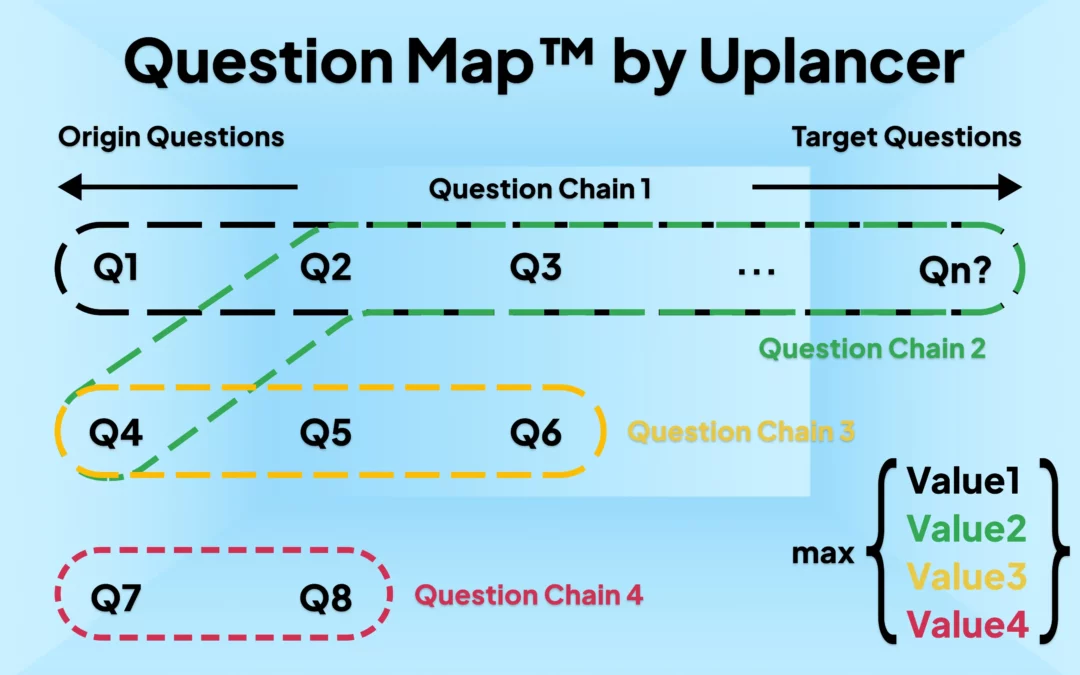
If you’re looking to dominate Answer Engine Optimization (AEO), the first step is to develop a Question Map™. It’s foundational to your content strategy, helping you understand and visualize your buyer’s journey across answer engines, such as ChatGPT, Perplexity, and Copilot. The need for a Question Map™ stems from how answer engines work: they not only answer our questions extremely well but also curate an engaging experience that encourages us to ask even more questions! We capture and order these questions in a Question Map™.
So let’s dive deeper into how to create and leverage one for better AEO below.
1. Generate Question Combinations
When we create a Question Map™, we always begin with buyer personas. We need to know things like:
- Buyer demographics
- Customer pain points
- Voice of the customer
These personas help shape the questions asked and inform how they’ll interact with answer engines. For example, an engineer will use different queries and may be more direct than a marketer or salesperson. Understanding these nuances is key to identifying the questions that matter most to your organization.
What remains is to generate the list of questions customers may ask in answer engines. As you do so, get familiar with target and origin questions:
- Target questions are questions where you want to appear, which may start with:
- Who’s the top…
- Find me the nearest…
- List out the best…
- Provide a company for…
- Origin questions are the first questions that a customer can ask, which may start with:
- How can I…
- Do I need…
- I need help with…
Pro tip: When generating your questions, we find it’s easiest to work backward from a target question and identify the lead-up questions.
2. Connect Questions into Sequences
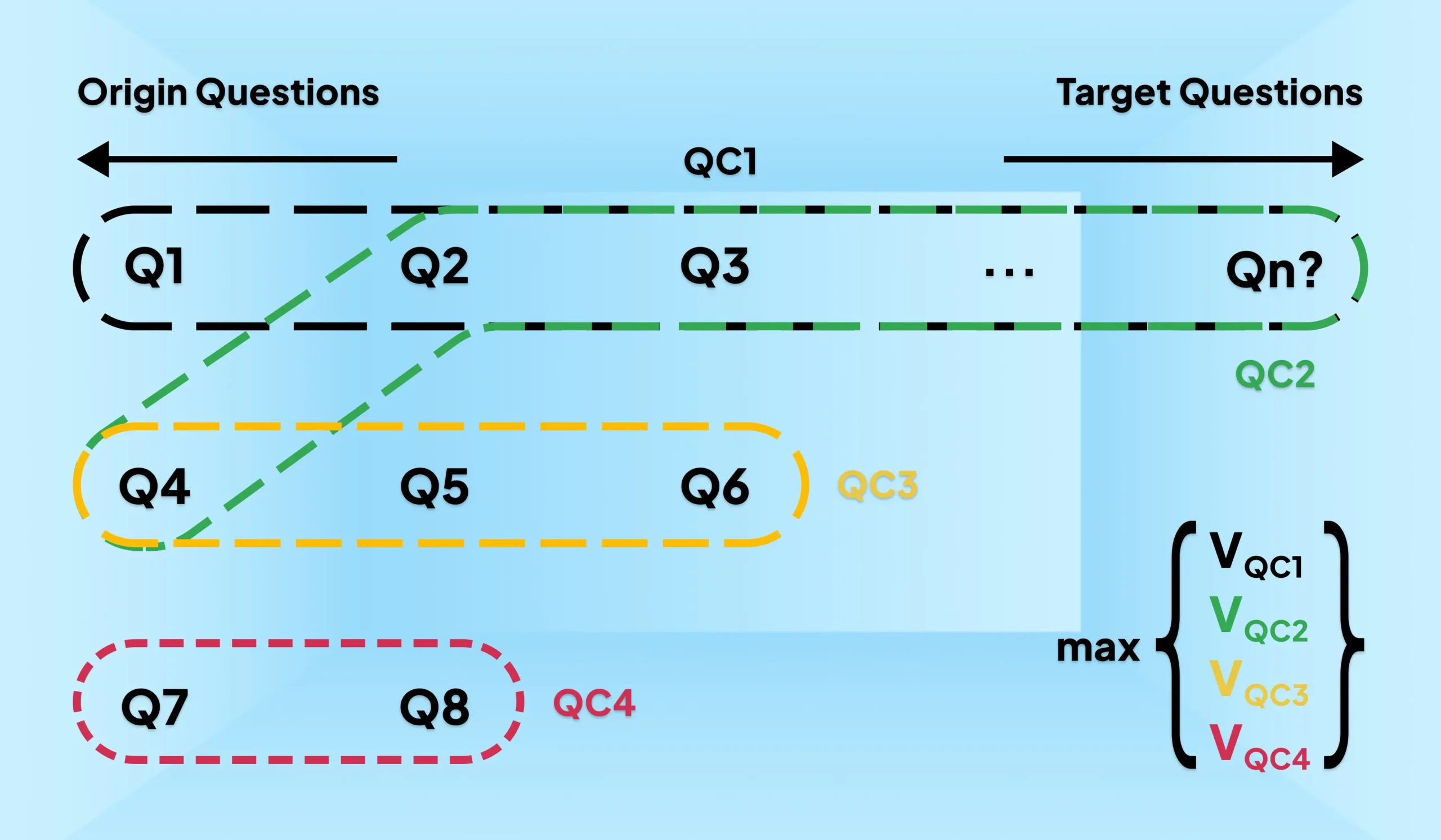
Starting with your origin question, connect it to the next logical question a user might think next. Keep doing this until you reach a target question. We call these sequences question chains (QC1, QC2, etc.), which help visualize the user path as they interact with an answer engine. You’ll
3. Determine the Value of Each Question Chain
Next, calculate values (VQC1, VQC2, etc) for each of your question chains. You’ll first need to build a prediction model using the following parameters:
- Keyword intent: What’s the goal for a given prompt/search (Commercial, Informational, Navigational, or Transactional)? The greater the intent, the higher the value.
- Traffic volume: How much traffic is there for a given prompt/search? The higher the traffic, the higher the value.
- Competition difficulty: How difficult is it to compete for a given prompt/search? The less competitive it is, the higher the value.
- Conversion potential: How likely is a conversion for a given prompt/search? More conversions mean higher value.
These parameters can be extrapolated from SEO tools, and if you’re not a math wizard, start with something simple. Once you’ve got these values calculated for each question chain, it’s time to prioritize them.
4. Target the Highest-Valued Question Chains
Prioritize your question chains according to value, from largest to smallest. This prioritization list serves as your playbook for AEO’s content marketing.
If you’re facing tie-breaker situations or want to explore a different valuation approach, try dividing your question chain values by the number of questions in each chain. This standardizes values at the question level to enable apples-to-apples comparisons.
5. Write SEO-Focused, Quality Content
Start with the highest-priority question chain and answer its questions through articles. For example, if a question chain consists of two questions, you should publish an article answering the first question and another article answering the second one. Work through the priority list and ensure your articles follow SEO best practices, as they are foundational to AEO!
6. Monitor Traffic and Performance from Search & Answer Engines
Once you publish your answer articles, periodically check on answer engines to see whether you appear in the responses to relevant questions. You’ll also want to review the following metrics:
- Referral Traffic: Monitor sources from ChatGPT, Perplexity, and other answer engines via Google Analytics’ source/medium report. You want to see an increase in this traffic type.
- Organic Traffic: Check Google Search Console and Bing Webmaster to ensure pages are indexed and receiving traffic. High-quality content that ranks well is more likely to be retrieved by AI answer engines.
- Bot Traffic: Confirm that key bots are crawling your website using server logs. Look for the following bot activity:
| Bot | Purpose |
| ChatGPT-User | Surfaces your site in ChatGPT answers |
| GPTBot | Crawls to train ChatGPT answer models |
| OAI-SearchBot | Surfaces websites in ChatGPT search |
| BingBot | Indexes content for Bing that’s used for Copilot and ChatGPT |
| ClaudeBot | Crawls for Claude AI training |
| Googlebot | Crawls and indexes content for Google |
| PerplexityBot | Surfaces sites in Perplexity search results |
| Perplexity-User | Provides answers with links in Perplexity |
| DuckAssistBot | Crawls for DuckDuckGo AI-assisted answers |
| Applebot | Crawls for Apple AI answer models |
Rinse and Repeat
Now that you’ve completed your Question Map™, you’ll want to revisit the above steps from time to time because:
- Questions may have been missed in a question chain
- Your answers to questions may have changed
- You may have developed a better predictive model for value.
That’s why, like SEO, AEO is ongoing: there’s always work to start, maintain, and improve.
Bottom Line:
Creating a Question Map™ is the first step for businesses taking AEO seriously. By generating question combinations, connecting chains, quantifying question chain values, and monitoring performance, you can position your content for maximum visibility across ChatGPT, Perplexity, Copilot, and other answer engines.
Need help with AEO? Connect today for a free consultation around our Question Map™ and how we can help you get your business listed on answer engines!