
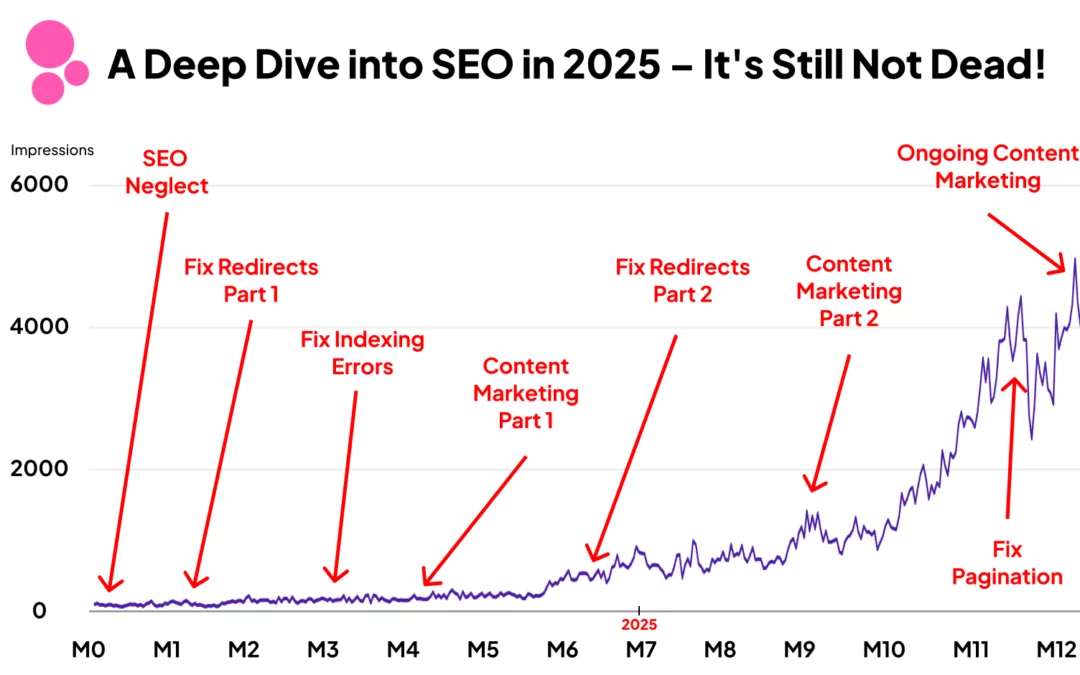
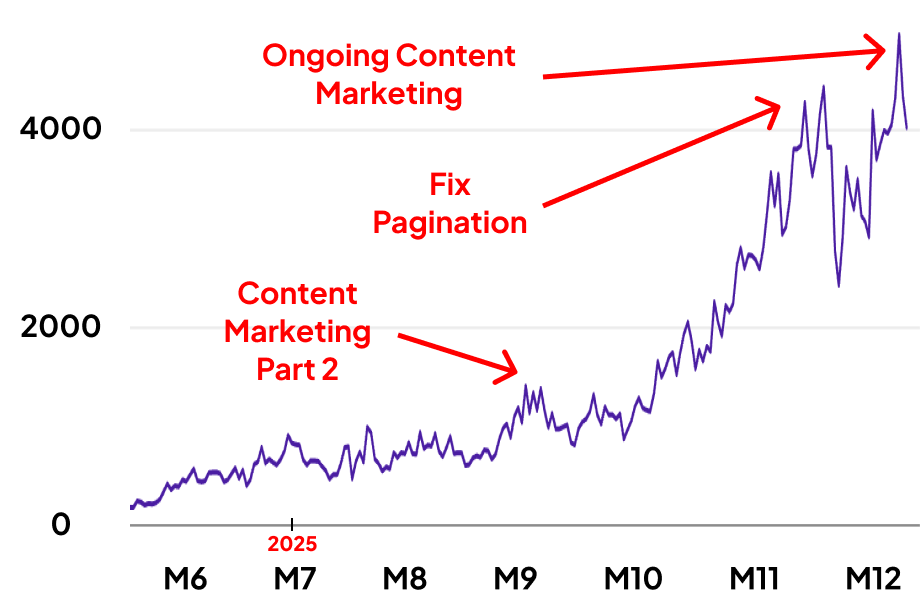
If you’ve been told that SEO is dead in 2025, you’ve been told wrong. As a Columbus marketing and SEO agency, we believe there’s no better way to prove this than by showing a real-world example. The image above captures our client’s SEO journey over a year, during which we increased their website impressions by 5,000%!
As such, we’ll walk you through this journey and our approach to fixing what felt like a lost cause for our client:
- What happened when nothing was done?
- The problems that we uncovered.
- The fixes that we made.
- The results that followed each fix.
SEO Neglect Is More Common Than You Think
Let’s first begin by looking at what happens when you don’t actively manage your SEO.
For years, our client maintained strong on-page content but did nothing else: no link building, SEO maintenance, or technical audits. This situation is common among small businesses: after launching their site, they see a spike in traffic, only to see it drop later. New competition and SEO efforts by existing competition explain this traffic drop.
If you find yourself doing the same, your organic traffic becomes limited to branded searches. At the same time, everything else, such as non-branded keywords, long-tail queries, and competitive topics, falls off the map.
Month 0: Planning and Strategy for a Killer SEO Program
We kicked off our engagement with a comprehensive audit to support their SEO revitalization. This audit revealed numerous site errors and content depth issues. If you’re unsure where to begin, an SEO audit is essential to map out what’s broken and what needs prioritizing.
As we delved deeper into the site, we uncovered technical SEO issues. Before we did anything else, we had to address them.
Month 1: Fixing Redirects (Part 1)
The biggest issue that we uncovered was the existence of four duplicate versions of their site:
- A direct IP address
- A staging subdomain
- An HTTP version
- A trailing slash
The issue? Search engines split the site’s SEO across these URLs. Therefore, pages weren’t consolidated under a single domain, which meant no URL received the full SEO value.
To fix this, we implemented server redirects, 301 redirects, noindex tags, and updated canonical URLs to consolidate everything under the primary domain: IPs, subdomains, HTTP, and trailing slash all point to https://domain.com
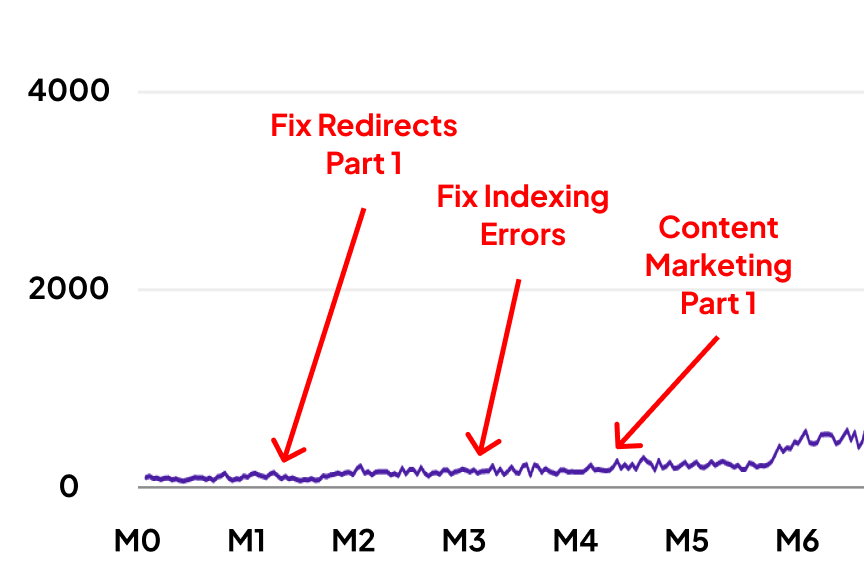
The impact: 100% increase in impressions to the primary domain.
Month 2: Cleaning Up Indexing Errors
Once redirects were in place, we noticed indexing issues plaguing their site. Webmaster Tools identified the following:
- 404 errors: Certain pages were published, indexed, and later removed. These pages needed proper 404 redirects.
- Duplicate content: We first assigned a canonical URL to attribute SEO to the correct page. The duplicated content was then rewritten and resubmitted for indexing.
- Discovered but not indexed: Content had been discovered for some time but never indexed. Reviewing the crawl logs revealed an excessive number of queued pages. We bypassed them by submitting the discovered pages for indexing.
- Redirect errors: Pages were published, and at some point, their URLs were edited. These pages needed 301 redirects.
We also used Moz and SEMrush to recrawl and identify additional issues that weren’t yet reported in the webmaster tools. We then resolved the issues and resubmitted the affected pages to GSC and BWT for reindexing.
The impact: 100% increase in impressions.
Month 3: Kickoff Content Marketing (Part 1)
With technical SEO under control, we turned to content marketing. For several months heading into 2025, we consistently published at least one high-quality article each week, targeting relevant keywords and user intent.
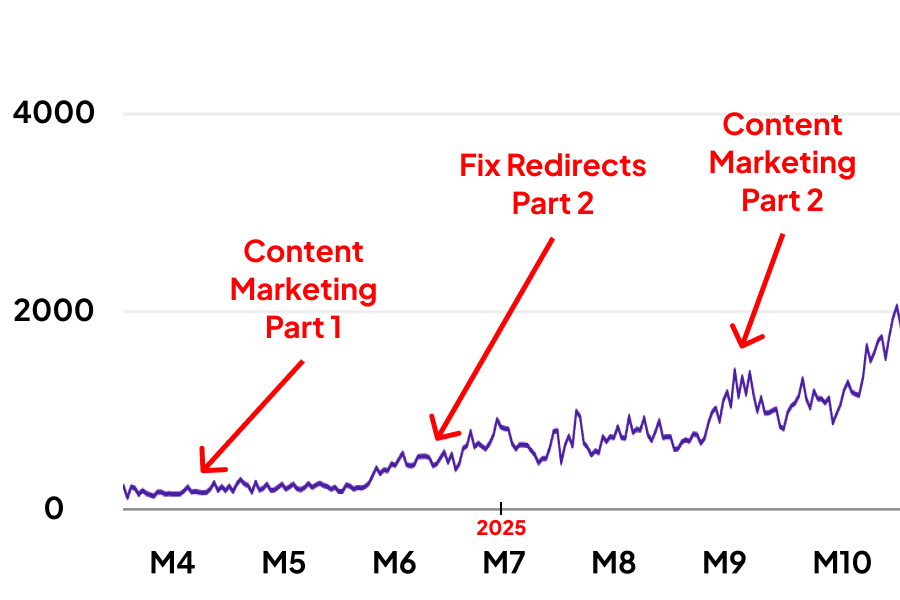
The results? Impressions really started to climb. The consistent publishing rhythm fueled organic growth across a wide range of long-tail queries. Note that Google indexing results took about 3 months to propagate.
The impact: 400% increase in impressions.
Month 6: Fixing Redirects (Part 2)
Despite our earlier fixes, different indexing problems emerged:
- The IP address was still indexed. We scanned all their links and found a few deprecated (no longer in use) internal links. Then we updated all internal links and canonical references to remove any trace of them.
- Similarly, staging was still being indexed. We set the meta directives to noindex on staging and assigned canonical URLs.
Once these were corrected, only a single, consistent domain appeared in search results, exactly as it should have been!
The impact: 200% increase in impressions.
Month 9: Content Marketing (Part 2)
We didn’t see anymore indexing issues, so we doubled down on content marketing again. The commitment to consistent, high-value publishing paid off when we switched to releasing 3+ articles each week. In just a few months, organic impressions skyrocketed!
The impact: 300% increase in impressions.
Month 11: Fixing Pagination Issues
Through ongoing maintenance, we noticed a sudden drop in impressions. We found that older articles were no longer accessible because pagination was not properly crawled by search engines.
When paginated links are missing or broken, it can “orphan” older posts, making them impossible for search engine crawlers to find.
To resolve the pagination issues, we followed pagination best practices by fixing the pagination and resubmitting the sitemap.
The impact: Impressions went back to their previous levels.
Month 12: Ongoing Content Marketing
This is the current status of their SEO program. We know our SEO works, and we are continuing content marketing.
Our Guiding Light:
From start to finish, we increased impressions by 5,000% over a year! Our client was happy, and we couldn’t be more thrilled about this.
The Bottom Line / TLDR
SEO is very alive and well.
If you neglect your site as our client did, it will stagnate or may even decline. But results will surely follow when you address your SEO issues, clean up indexing, and invest in content marketing.
Here’s what you should take away from our analysis:
- Start with a comprehensive SEO audit
- Fix redirects and eliminate duplicate domains
- Resolve indexing issues via Google Search Console
- Build and execute a consistent content marketing strategy
- Ensure paginated content remains crawlable
- Monitor results and stay persistent
- Most importantly, SEO is an ongoing effort
Need help with SEO? Contact us for a free consultation and audit of your website today!